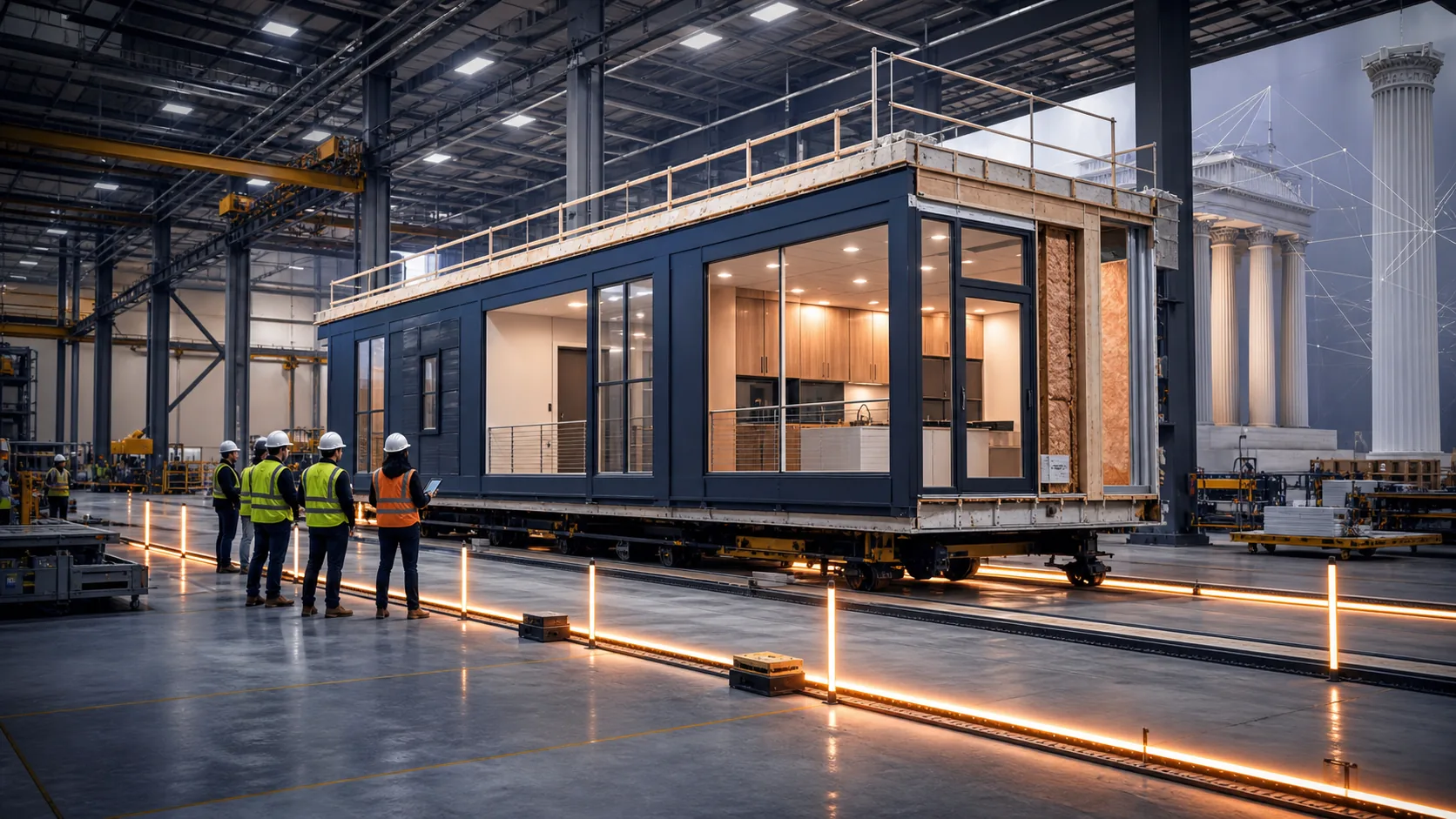
The 21st Century ROAD to Housing Act became law on July 11, 2026. For the modular construction sector, the most important change is not an instant subsidy or a new national building code. It is a federal mandate to examine whether existing Federal Housing Administration construction-finance programs fit the way factory-built projects actually spend money and reach completion.
Financing Moves Onto the Implementation Agenda
The final package includes the Modular Housing Production Act. According to the Senate Banking Committee's public fact sheet, the provision requires FHA to assess barriers to lending for modular housing and directs the Department of Housing and Urban Development to consider changes to loan draw schedules. The enrolled text is H.R. 6644, a broad housing package that also covers permitting, local planning, manufactured housing, rehabilitation, disaster recovery and other federal programs.
This distinction matters. Conventional construction lending often releases funds against visible progress at the jobsite. Modular projects can commit substantial capital earlier, while structural assemblies, mechanical systems and interior finishes are advancing inside a factory. A draw process designed around site work may therefore lag the project's real cost curve. The new law does not rewrite those mechanics overnight, but it requires the mismatch to receive formal federal review.
Modular and Manufactured Housing Take Different Paths
The law addresses both modular and manufactured housing, but the categories are not interchangeable. The National Conference of State Legislatures summarizes modular homes as factory-built dwellings produced in one or more modules, built to applicable state and local codes, transported to a site, placed on a foundation and completed there.
Manufactured housing receives a separate structural change. The law broadens the federal definition so a manufactured home may be built with or without a permanent chassis, while directing HUD to establish standards and identification for chassis-free units. That provision could widen design and siting options, but it should not be presented as a blanket removal of state implementation requirements. NCSL notes that states must certify conforming treatment within the law's timetable.
What Changes Now and What Does Not
The immediate change is direction: modular finance is now a defined federal implementation issue rather than only an industry request. HUD and FHA must turn statutory language into reviews, findings and, potentially, program changes. Developers should not assume that underwriting standards, advance rates or draw schedules have already changed.
The law also leaves major project fundamentals intact. Modular buildings still must satisfy applicable state and local codes. Local approvals, site control, utility coordination, transport planning, foundations, crane access and closeout remain decisive. NCSL also reports that the package does not itself add funding for federal housing initiatives, even though it modifies and creates program authorities.
What Project Teams Should Prepare
The review creates a practical window for modular developers, manufacturers and lenders to document where conventional finance creates friction. Useful evidence will be specific: the share of project cost incurred offsite before set day, the timing of long-lead purchases, inspection points inside the factory, title and collateral questions, payment milestones, retainage, stored-material controls and the gap between factory completion and site installation.
Teams that can map those facts to auditable production milestones will be better positioned for any future program change. The strongest case is not that modular construction should receive lighter oversight. It is that oversight can be aligned with a different production sequence while preserving verification, quality control and lender security.
A Policy Signal, Not an Automatic Market Win
The law's bipartisan passage and July 11 enactment make modular housing part of a wider federal housing-supply strategy. Independent reporting from the Associated Press describes the package as an effort to lower housing costs and accelerate construction, while also noting that it does not solve labor shortages, insurance pressures or every other constraint on delivery.
For the modular sector, that is the right scale of expectation. Financing reform can remove a real bottleneck, but it cannot rescue an underwritten project with weak demand, poor site readiness or unreliable production. The opportunity is narrower and more useful: federal housing finance may begin to recognize that factory progress is project progress. The next meaningful signals will come from HUD's review, any proposed changes to draw policy and the evidence industry participants bring to that process.
Sources: U.S. Government Publishing Office (H.R. 6644 enrolled), U.S. Senate Banking Committee, National Conference of State Legislatures, Associated Press. Hero image: AI-generated editorial illustration; it does not depict a specific factory or policy event.