On July 14, 2026, the Modular Building Institute released its latest U.S. permanent modular construction report, developed with FMI Consulting. The headline estimate is substantial: the U.S. market reached $20.5 billion in 2025, equal to about 5.1% of construction activity in the key segments covered by the report, and is projected to grow at a 6.5% compound annual rate through 2030.
Those numbers deserve attention, but they also need careful framing. This is an industry market estimate, not a federal count of every modular project, and the 5.1% share refers to selected addressable construction segments rather than all U.S. construction. The forecast is a forward-looking scenario, not guaranteed revenue. Used correctly, the report is less a victory lap than a map of where modular construction is gaining traction—and where execution still determines who captures the growth.
What the Growth Forecast Actually Implies
If the $20.5 billion base and 6.5% annual growth rate hold for five years, the market would approach $28.1 billion by 2030. That calculation is an implication of the published forecast, not a separate MBI estimate. It shows the scale of the opportunity: roughly $7.6 billion in additional annual market activity would need to be supported by factories, design teams, suppliers, lenders, inspectors, transport networks, and installation crews.
The report identifies multifamily residential as the largest market. It also points to office and data center construction as emerging opportunities, while the U.S. West leads in market size because housing affordability pressure and disaster recovery create demand for faster, more predictable delivery. These are different product markets with different technical requirements. A factory that performs well in repeatable multifamily modules is not automatically configured for data center skids, healthcare rooms, or relocatable public facilities.
Market Growth Is Not the Same as Factory Health
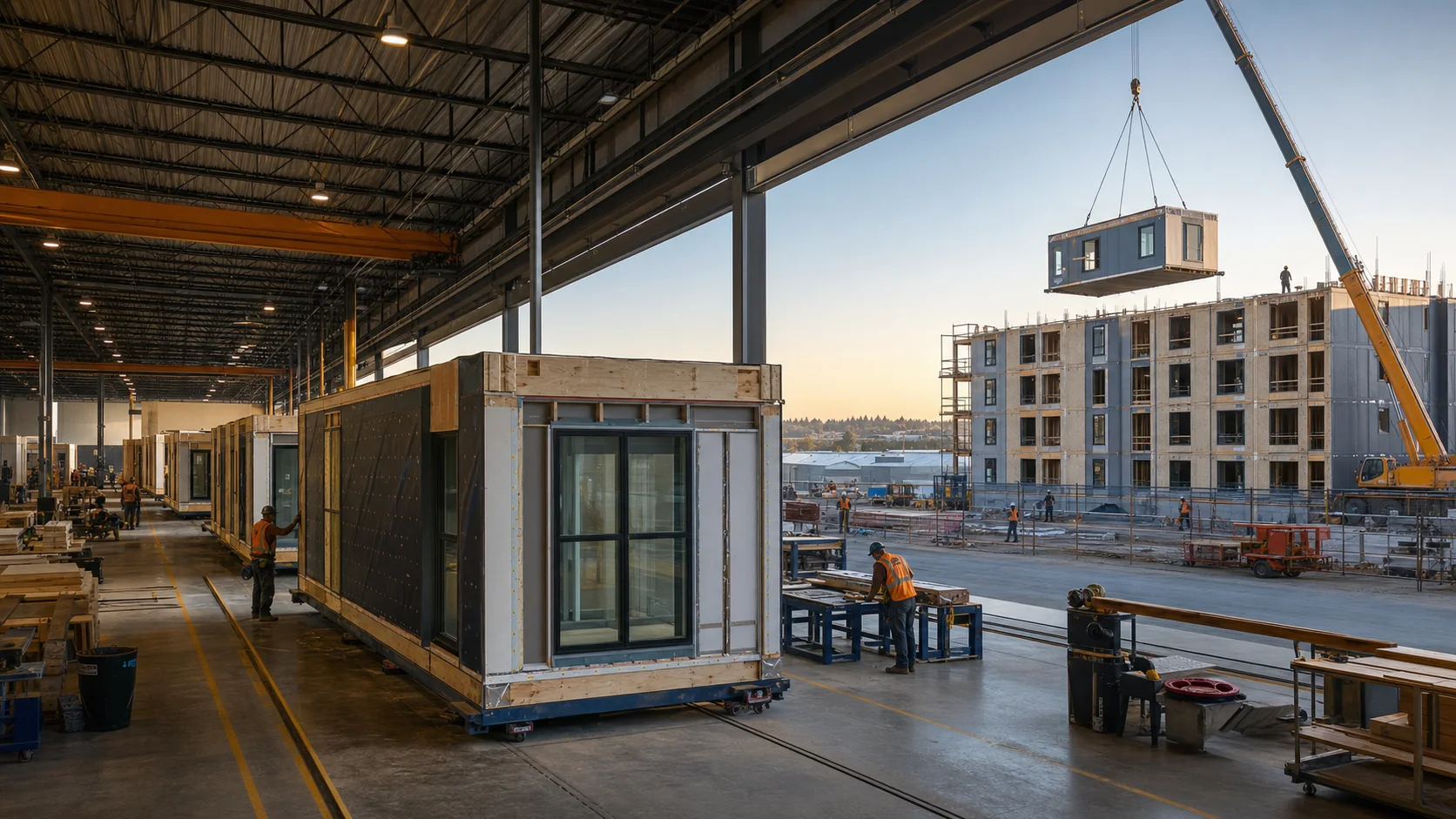
MBI says factory production can shorten project timelines by 20% to 50%, improve quality control, reduce onsite disruption, and help owners reach occupancy sooner. The range is meaningful, but it should not be treated as a universal promise. Schedule value appears when site work and factory production truly run in parallel, decisions are frozen early enough for manufacturing, procurement is synchronized, and installation is planned before modules leave the line.
That operating model changes the risk profile. Conventional projects can absorb some design development in the field. Modular projects move more decisions and spending forward. Late changes can interrupt repeatable production, strand purchased material, or force rework across multiple units. Haskell's description of modular delivery makes the integration requirement clear: design, manufacturing, procurement, logistics, and installation operate as one connected system.
For manufacturers, the central metric is not theoretical factory capacity. It is capacity supported by a reliable, financeable pipeline. Adding line space without enough standardized backlog can reduce utilization and increase working-capital pressure. For developers, reserving factory capacity without site readiness, approvals, or a locked design can create the opposite problem: a production slot exists, but the project cannot use it.
The Report's Barriers Are the Real Industry Agenda
The new report names financing gaps, permitting and regulatory inconsistency, uneven project pipelines, design coordination challenges, and limited modular experience among project teams as continuing barriers. These are not side issues. Together they explain why a delivery method can demonstrate schedule advantages and still struggle to scale consistently.
Financing must recognize verified value created inside the factory, not only visible work at the site. Permitting needs a defined division between state or third-party factory review and local site review. Design teams need earlier decisions on grids, connections, fire assemblies, MEP interfaces, tolerances, transport envelopes, and set sequencing. Owners need procurement structures that bring manufacturers into the project before conventional documents are effectively complete.
The broader construction market also remains selective. FMI's 2026 North American outlook expects U.S. and Canadian construction performance to vary sharply by sector, with overall growth far more restrained than the modular forecast. That difference can create opportunity, but it also raises the standard for evidence. Owners will ask whether modular improves the economics of their specific asset, not whether the category is growing in aggregate.
Five Measures Project Teams Should Track
Teams evaluating modular delivery can turn the market report into a practical operating dashboard:
- Pipeline conversion: the share of qualified opportunities that reach a signed production commitment, not just an early feasibility study.
- Design-freeze reliability: how often critical module decisions remain stable after release to manufacturing.
- Factory utilization: productive line time supported by confirmed work, measured without hiding changeover, rework, or idle periods.
- Parallel-work performance: whether site readiness, foundations, utilities, and factory completion converge on the planned set date.
- Cash and inspection milestones: whether lender draws and owner approvals follow auditable offsite progress closely enough to support production.
These measures connect market demand to execution. They also help owners distinguish a modular strategy from a conventional project that merely purchases boxes late in the process.
A Larger Market Raises the Standard
The July 14 report is strong evidence that permanent modular construction is no longer a fringe delivery method in its core U.S. segments. It is not evidence that every building should be modular, that every factory will thrive, or that forecast growth will arrive evenly across regions and asset classes.
The industry value of the report lies in that tension. A $20.5 billion market can support deeper specialization, better financing products, more experienced design teams, and more consistent public-sector processes. But scale also exposes weak pipelines, fragmented responsibilities, and factories built ahead of demand. The companies that benefit most from the next five years will be those that treat modular as an integrated production system—commercial, technical, and financial—not simply a faster construction technique.