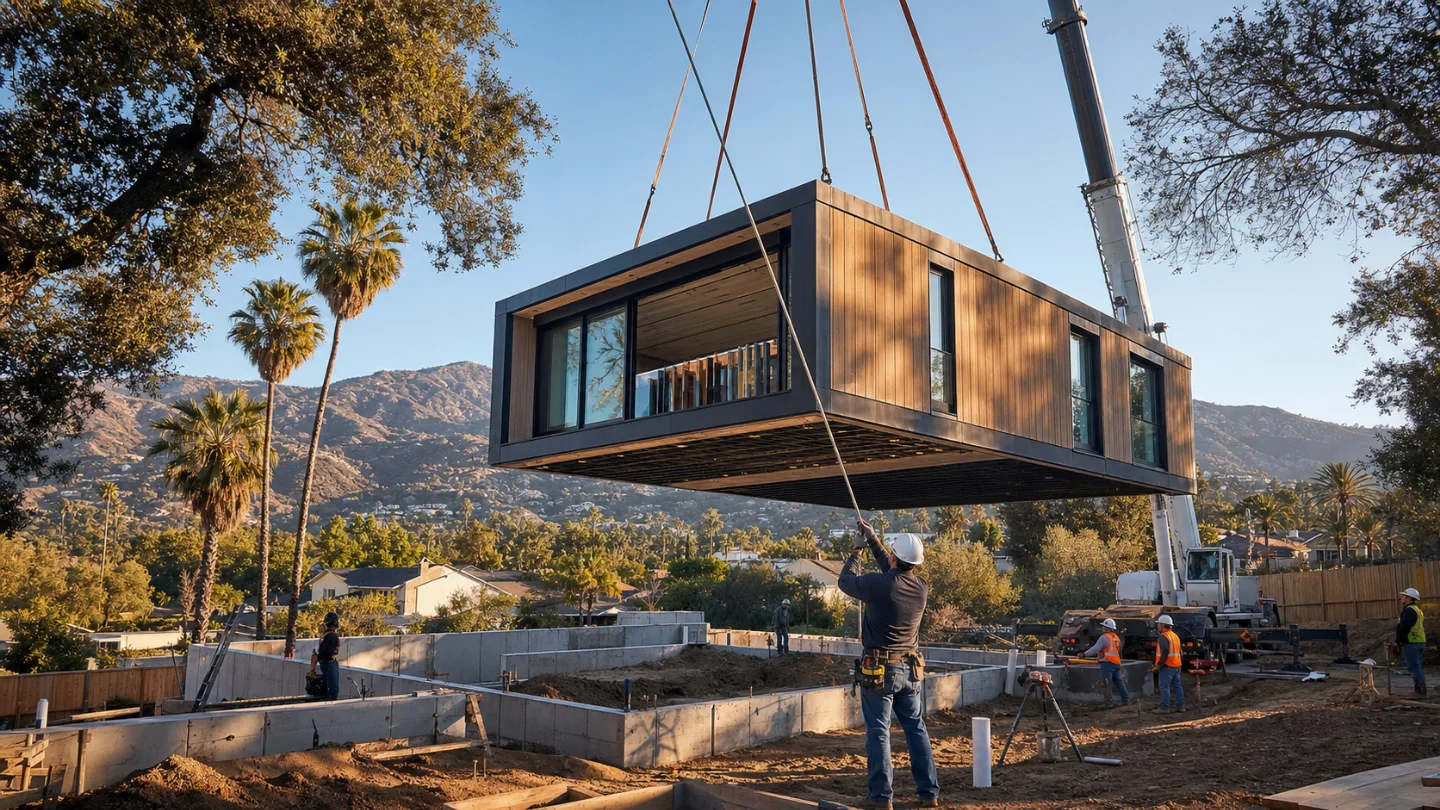
Factory-built housing is moving from industry promise to a visible role in Southern California's recovery. On July 7, the Los Angeles Times reported that prefab manufacturers are supplying replacement homes in neighborhoods affected by the Eaton and Palisades fires, giving residents and local officials a real-world test of whether offsite production can deliver faster reconstruction without sacrificing design quality.
A Recovery Market Large Enough to Test the Model
The scale is significant. More than 12,000 homes were destroyed in the two fires, while Plant Prefab told the Times it had 97 replacement homes under contract. A volunteer group called Friends of Prefab assembled examples from 33 firms, and a limited drive-by survey identified 24 prefab projects in part of Altadena — roughly one in nine rebuilds observed in that sample. Those figures do not establish market share for the full recovery, but they do show that prefab is no longer merely hypothetical.
The report also documented different production strategies. Plant Prefab is manufacturing customized homes from a 270,000-square-foot facility in Arvin, California. Reframe Systems delivered its first Altadena home in April using six modules placed by crane on precast foundations. Its micro-factory approach is designed to add regional capacity without betting on a single massive centralized plant.
The Engineering Case Is Getting More Specific
A July 1 analysis from the American Society of Civil Engineers placed this activity in a broader housing context. ASCE cited a national shortage exceeding 4.7 million homes and noted that a conventional home can take about 10 months and involve an average of 24 subcontractors. Factory production can shift more work into a controlled environment, reduce weather exposure, and let smaller site crews install coordinated assemblies.
The same engineering analysis also highlighted the tradeoff developers must understand: offsite construction front-loads decisions. Structural, envelope, MEP, finish, logistics, and code questions have to be resolved before production. That discipline can reduce downstream change orders, but it rewards teams that bring the manufacturer into design early rather than treating fabrication as a late procurement package.
Federal Attention Is Following the Field Work
HUD added another signal on July 2, announcing that its 2026 Innovative Housing Showcase will return to the National Mall September 22–24. The agency says the event will include full-sized prototype homes and new building technologies aimed at expanding housing supply and lowering construction costs. The announcement is not a funding award or code change, but it does show that industrialized housing remains part of the federal housing conversation.
What Developers Should Watch Next
The Los Angeles recovery will provide unusually practical evidence on questions that have slowed adoption elsewhere:
- Can factories preserve neighborhood-specific architecture while repeating enough components to gain efficiency?
- Can permitting, utility coordination, transport, foundations, and crane installation move as one integrated schedule?
- Can regional micro-factories maintain steady demand after the immediate recovery cycle?
- Will insurers and lenders treat factory progress as financeable work in place?
Prefab is not an automatic shortcut. Site conditions, local approvals, financing, and design changes can erase factory gains. But the 2026 evidence is becoming more concrete: real homes are being delivered, regional capacity is expanding, and the engineering profession is treating industrialized construction as a serious housing-delivery system rather than a novelty.
Reporting sources: Los Angeles Times, July 7, 2026; American Society of Civil Engineers, July 1, 2026; U.S. Department of Housing and Urban Development, July 2, 2026. Hero image: AI-generated editorial concept by TerraCore; it does not depict a specific reported project.