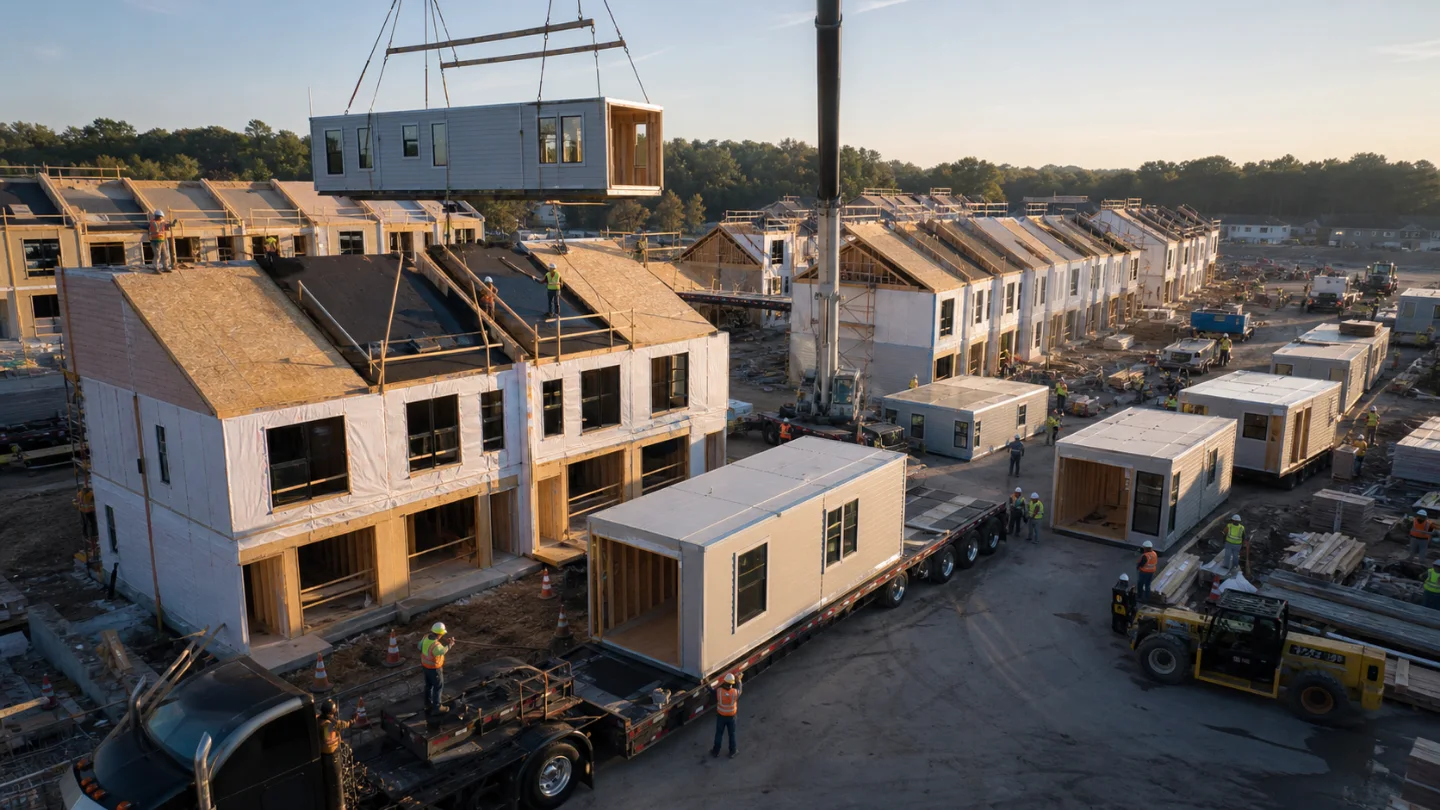
The United States is short approximately 4.5 million housing units, according to recent estimates — a deficit that has deepened despite increased construction starts over the past two years. The shortage is driven not by a lack of demand or capital, but by a structural constraint that conventional methods have proven unable to solve: there are simply not enough skilled construction workers to build the housing America needs at the pace it needs it.
The Labor Math Doesn't Add Up
The U.S. construction industry is short over 500,000 skilled workers — a gap that demographic trends suggest will widen, not narrow, through 2030. Older tradespeople are retiring faster than apprentices enter the workforce. Immigration policy changes over the past decade have reduced the inflow of construction labor. And younger workers, facing a strong job market, are not choosing construction careers at replacement rates.
Factory-built construction addresses this not by finding more workers for job sites, but by moving the work to a different labor market entirely. Factory production workers are a separate workforce — operating CNC cutting equipment, assembling panels on jigs, and routing MEP systems indoors — with different skill profiles, different working conditions, and different recruitment channels than site-based trades.
Manufactured Housing Enters the Mainstream Conversation
A recent New York Post / Realtor.com analysis identified factory-built housing — including modular and manufactured homes — as one of the most viable solutions to the housing affordability crisis. The analysis noted that modern factory-built homes "bear little resemblance to the mobile homes of decades past" and highlighted that they can be produced at a cost 20–30% lower than comparable site-built homes while meeting the same building codes.
This marks a significant shift in public perception. For decades, "manufactured housing" carried a stigma — associated with trailer parks and low-quality construction. Today's factory-built homes are precision-engineered structures, built to the same IBC and IRC codes as site-built construction, with the added quality advantages of controlled-environment production and multi-point inspection before leaving the factory.
The Modular Construction Institute's 2026 Outlook
The Modular Building Institute (MBI) released its 2026 industry reports this week, providing the most comprehensive data available on modular construction trends, market growth, and segment performance. While the full reports are available to MBI members, preliminary indicators point to sustained double-digit growth in the modular construction sector, driven primarily by multifamily residential, hospitality, and healthcare applications.
MBI's analysis confirms what developers on the ground have been experiencing: demand for offsite construction capacity is outpacing supply. Factory slots are booking further out, and the developers who secure capacity early are gaining structural advantages in their markets.
What This Means for Developers
For developers considering their first prefab project, the window to secure factory capacity and establish the necessary relationships — with lenders, permitting agencies, and installation crews — is open but narrowing. The developers who act in 2026 will have completed their first projects and be ready to scale before the capacity crunch hits hardest.
Key takeaways:
- The U.S. housing deficit of 4.5 million units cannot be solved with site-built construction alone
- Factory-built housing is gaining mainstream credibility as a quality, code-compliant solution
- The modular construction industry continues to grow at double-digit rates
- Early movers who secure factory capacity now will have significant advantages over late entrants
Sources: NY Post / Realtor.com, Modular Building Institute 2026 Industry Reports, TerraCore market analysis. Image: TerraCore factory production floor.