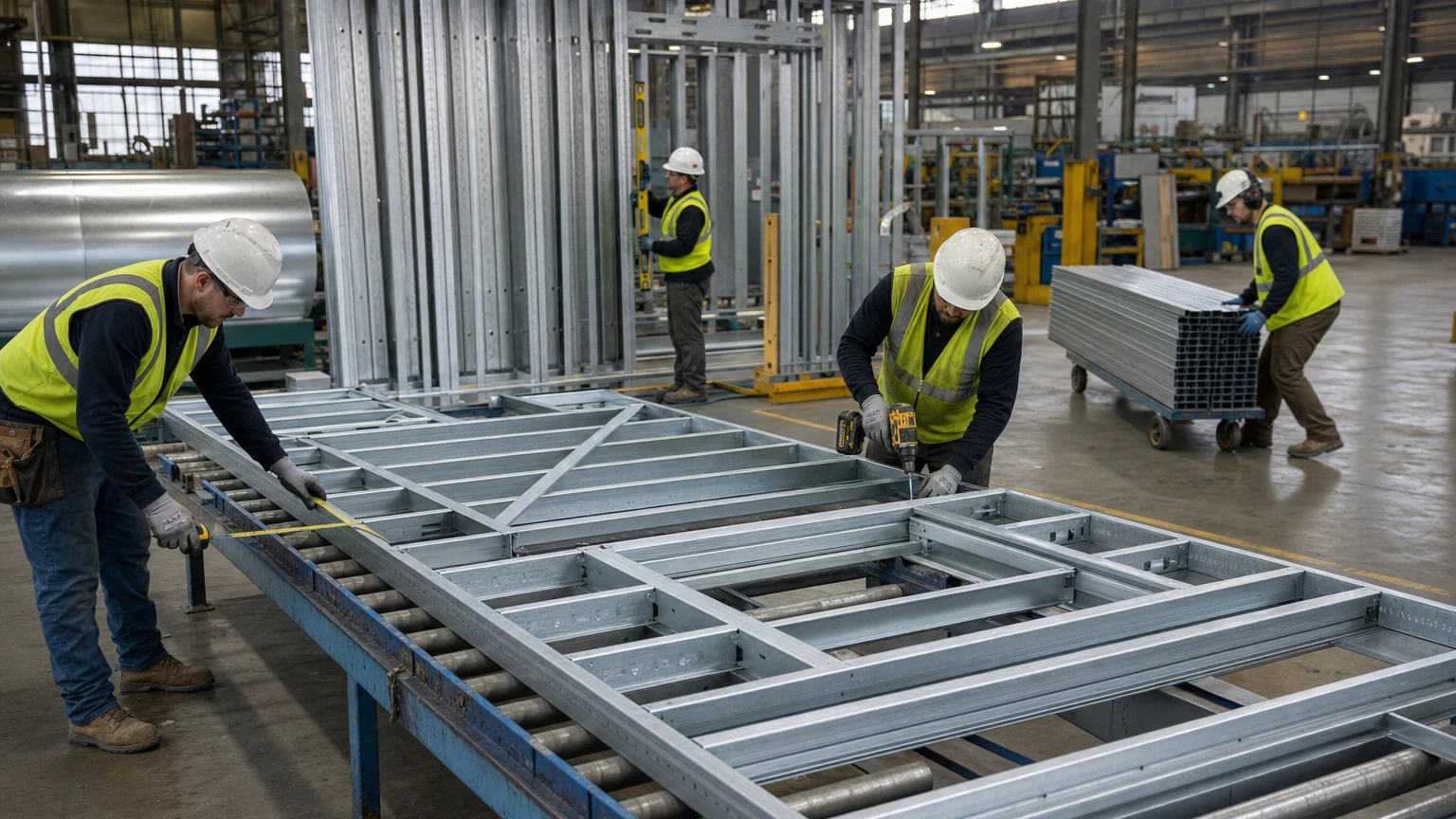
Colorado has spent several years treating off-site construction as industrial policy, housing policy, and workforce development at the same time. A July 16 Denver Post report puts the scale of that experiment at roughly $70 million invested across 18 modular and off-site housing manufacturers. It also sharpens the question that matters now: can public support create factories that survive uneven demand and convert capacity into completed, affordable homes?
The question is timely because the state’s manufacturing base is changing. The Denver Post reported that Clayton Homes closed Colorado’s largest modular plant in late 2025. At the same time, newer manufacturers backed through the Innovative Housing Incentive Program and Proposition 123 are moving from startup plans to production. Aurora-based Vederra Modular is one of the clearest examples: a 140,000-square-foot factory, a deliberately lean equipment strategy, and a near-term focus on mountain-community housing where shorter construction seasons make parallel site and factory work especially valuable.
Public Capital Bought Capacity—Not Guaranteed Throughput
Colorado’s official funding record shows how the strategy was assembled. In February 2024, the state announced $38 million in below-market factory financing for eight manufacturers projected to create 4,755 units of annual capacity and 1,280 jobs. Vederra’s package included a $2.5 million Innovative Housing Incentive Program loan and $3.5 million in cash-collateral support through Proposition 123, tied to a projection of 316 units annually.
A later state award added a $1 million Proposition 123 line of credit and a $1.8 million IHIP loan for a movable factory pilot intended for disaster response and regions without established homebuilding capacity. Across the wider program, Colorado now lists 18 operating manufacturers using modular, panelized, precast, kit, and 3D-printing systems. The portfolio approach reduces the risk of depending on one technology, but it does not remove the commercial problem each factory faces: fixed overhead continues even when orders do not.
This distinction between capacity and throughput is essential. A funding announcement can measure square feet, jobs, and units per year. Factory health depends on signed projects, repeatable designs, timely approvals, working capital, and a production sequence that is not repeatedly interrupted. Public investment can lower the cost of entry. It cannot substitute for a reliable backlog.
The Lean-Factory Argument
The Denver Post’s Vederra case study contrasts a low-overhead launch with the capital-intensive automation model associated with earlier construction startups. Vederra leases its facility, acquired some equipment at distressed prices, and has limited its robotics investment. That approach is not anti-technology. It is an attempt to keep the break-even point low enough to withstand gaps between projects.
For modular manufacturers, the relevant automation question is not whether a machine can perform a task faster. It is whether product volume, design repetition, changeover time, maintenance cost, and labor savings produce an acceptable return across a realistic pipeline. Flexible fixtures, digital quality records, material flow, and labor planning can create value before a factory commits to highly specialized automation.
The lesson for owners and manufacturers is practical: match the production system to contracted demand, not to a best-case utilization forecast. A smaller, adaptable line with disciplined takt planning may outperform a highly automated facility if the project mix remains variable.
A Cost Claim That Needs Full-System Accounting
Vederra and engineering partner EVstudio are preparing to test an approach called Alt-Mod on affordable housing in Granby. According to cost figures reported by the Denver Post, the design reduces duplicated walls and floors between adjacent modules, cutting the planned box count from 93 to 47. Factory component cost was estimated to fall from $13.7 million to $9.4 million, while onsite completion labor rises. The reported all-in comparison is $18.7 million versus $22.6 million for a more conventional modular approach—a projected 17% reduction.
| Metric | Conventional | Alt-Mod estimate |
|---|---|---|
| Planned box count | 93 | 4746 fewer (about 49%) |
| Factory component cost | $13.7M | $9.4M$4.3M lower (about 31%) |
| All-in project cost | $22.6M | $18.7M$3.9M lower (17%) |
Those figures are promising, but they are project estimates rather than completed-project results. The tradeoff is important: less material and fewer transported boxes can lower factory and logistics costs, but leaving more work for the site shifts labor, weather, sequencing, quality-control, and schedule risk back into the field.
The right evaluation is therefore not “fewer modules equals lower cost.” Teams should compare the full installed system: factory labor and materials, transport, crane picks, site finishing, temporary protection, inspection responsibilities, punch work, financing carry, and the cost of delay. If the Granby project verifies the projected savings after completion, the method could be meaningful for multifamily housing. Until then, it should be treated as a measured field test.
Code Reform Can Turn Standardization Into Inventory
Capital is only one side of Colorado’s strategy. SB25-002 required regional standards for factory-built structures that account for climate, geography, and fire protection, while limiting local rules that discriminate against factory-built housing. The state framework also provides for third-party plan review and clearer responsibility among manufacturers, installers, contractors, and inspectors.
That matters operationally because repeatability disappears when the same approved design must be resubmitted as a fundamentally new product for every nearby address. More consistent regional requirements can allow manufacturers to reuse approved designs, plan material purchases, and—in suitable product categories—build limited inventory before a specific buyer is ready.
Uniformity does not mean ignoring local conditions. Colorado spans multiple climate zones and significant wildfire, snow, wind, and access constraints. The useful policy objective is a known regional rule set, not a single detail applied everywhere. Predictability lets designers and factories incorporate those differences before production rather than discover them during local review.
What the Colorado Experiment Should Measure Next
Colorado’s program will be most useful to the broader modular industry if performance is measured beyond announced capacity. Five indicators would show whether the strategy is converting public capital into durable delivery capability:
- Completed affordable units: delivered and occupied homes, separated from projected annual capacity.
- Factory utilization and backlog quality: productive line time supported by financeable contracts rather than nonbinding leads.
- Cost at completion: the full installed cost, including site work, financing carry, change orders, and warranty work.
- Approval cycle time: elapsed time for state, third-party, and local reviews before and after regional-code implementation.
- Public-capital performance: repayments, defaults, jobs retained, and production sustained after incentives taper.
The state’s approach is ambitious and directionally aligned with the industry’s real constraints. It combines factory finance, per-unit incentives, affordable-housing requirements, and regulatory reform. But the next phase is less about announcing factories and more about keeping them productively loaded.
From Industrial Policy to Repeatable Delivery
Colorado’s modular housing bet is not proven or disproven by one plant closure, one startup, or one project estimate. The more useful reading is that off-site construction behaves like manufacturing: it rewards standardization, flow, and repeat demand, while punishing oversized overhead and unstable pipelines.
For developers, the implication is to bring manufacturers into design, approvals, financing, and site planning early enough for factory production to remain repeatable. For manufacturers, it is to scale equipment and staffing against contracted work rather than headline market demand. For public agencies, it is to track occupied units and factory durability—not just theoretical capacity.
If Colorado can connect those pieces, its program could become a replicable model for states seeking more housing and stronger construction productivity. If the pipeline remains fragmented, public funding may create capacity that the market cannot consistently use. The execution phase will decide which outcome prevails.